Last Updated: April 2026 (Updated to reflect full 20-month campaign: May 2024 – December 2025)
Note: Some data has been anonymized to maintain client confidentiality. Additionally, this case study data may not reflect the most current information; please refer to the Looker dashboard for updated data.
This case study reveals how we helped a legal SaaS company break free from expensive, underperforming Google Ads and build a sustainable organic lead generation engine. Over 20 months, we grew organic sessions from 756 to a peak of 12,176 — a 16x increase — while generating 187 Marketing Qualified Leads and 20 new customers through strategic SEO. What began as a fragile, ad-dependent domain became a dominant organic player in the US legal technology market.
Table of Contents
Executive Summary: The “Big Win”
Before diving into the strategy, here is what this campaign achieved over 20 months (May 2024 – December 2025):
| Metric | Baseline (May 2024) | Peak / Final (Dec 2025) | Growth |
|---|---|---|---|
| Organic Sessions | 756 | 12,176 | 16x increase |
| Non-Branded Clicks (GSC) | 77 | 8,964 | 11,542% increase |
| USA Clicks (GSC) | 12 | 2,379 | 197x increase |
| Total GSC Clicks | 319 | 9,199 | 2,784% increase |
| Marketing Qualified Leads | — | 187 total | — |
| Customers Acquired | 0 | 20 | — |
| Bing Organic Clicks | 5 | 683/month | 13,560% increase |
Two unique angles set this case study apart from most SEO results:
- The AI Overview Recovery: We identified 70+ pages losing traffic to Google’s AI Overviews and recovered 1,300+ lost clicks by engineering crawlable “Takeaway” sections — a tactic most SEO teams haven’t operationalized.
- The Listing Blog Powerhouse: A focused set of “Best of” listing pages averaged 1,089 clicks per page — the highest-performing content type in the portfolio — proving that BOFU content beats volume plays every time.
The Challenge: A New SaaS Struggling with Lead Generation
When this legal SaaS company approached us in May 2024, they were facing a critical challenge that many early-stage SaaS companies encounter. Despite having built an innovative AI-powered solution that solved major pain points in the legal industry at a much lower price point than competitors, they were struggling to generate qualified leads cost-effectively.
Their situation was particularly concerning:
- Brand new domain with minimal organic presence
- Heavy reliance on Google Ads that had consumed significant budget over the past year
- Extremely low MQL (Marketing Qualified Lead) conversion rates from paid campaigns
- Difficulty converting even the few MQLs they generated into paying customers
- Traffic was almost entirely from brand searches to their homepage
The client’s primary goal was crystal clear: generate Marketing Qualified Leads through organic channels. They weren’t interested in vanity metrics like clicks or impressions — they needed prospects who would actually convert into customers.
The competitive environment made this harder than it sounds. The niche — high-ticket B2B Legal Tech — is dominated by well-funded, established market leaders with domain ratings north of 70. Starting with near-zero domain authority meant every early piece of content was climbing a steep hill.
Our Strategic Approach: Building from Ground Zero
Phase 1: Deep Discovery and Intelligence Gathering
Before touching any content or technical elements, we invested heavily in understanding the business inside and out. This wasn’t just a standard questionnaire — we conducted comprehensive research across multiple dimensions:
Product Intelligence:
- Conducted detailed product demos to understand core features and use cases
- Mapped out their Ideal Customer Profile (ICP) and user personas (Contract Managers, Legal Counsels, Operations teams)
- Identified their unique AI integration and compliance requirements
- Analyzed their pricing structure and trial/freemium model
Competitive Landscape:
- Initially received their core competitor list
- Expanded research to identify 40-50 additional competitors for verification
- Analyzed what made them uniquely positioned in the market
Technical Foundation:
- Gained access to GSC, GA4, Microsoft Clarity, Bing Webmaster, and GTM
- Understood their CMS capabilities and development resources
- Mapped their lead tracking system and CRM integration
This discovery phase was crucial because it created a comprehensive knowledge base in Notion that would guide every strategic decision moving forward.
Phase 2: Technical Foundation and Experience Audit
Technical SEO Assessment: We ran comprehensive audits using Ahrefs and ScreamingFrog to identify technical issues. Fortunately, being a new site with limited pages meant fewer technical complications to resolve.
Experience Audit — The Game Changer: This is where we went beyond traditional SEO tools. We manually evaluated every user touchpoint:
- How effectively were CTAs positioned throughout the user journey?
- Did the content structure guide users toward conversion?
- Were there sufficient downloadable resources and gated content opportunities?
- How well did internal linking keep users engaged and increase pages per session?
- Did the site demonstrate E-E-A-T (Experience, Expertise, Authoritativeness, Trustworthiness) factors?
This experience audit revealed numerous optimization opportunities that automated tools couldn’t detect.
Phase 3: Competitive Intelligence and Market Positioning
We selected 4-7 core competitors for deep analysis, examining:
- Traffic patterns and keyword distributions
- Content strategies across different funnel stages
- Backlink profiles and domain authority factors
- Conversion optimization tactics and lead capture methods
- Geographic traffic distribution (crucial for US market targeting)
- Presence in featured snippets and AI overviews
This analysis revealed clear patterns in successful competitors’ strategies and identified gaps we could exploit.
Phase 4: Content Strategy — The Hub and Spoke Model
Rather than publishing broadly, we built a disciplined “Hub and Spoke” architecture where high-authority “Hub” pages (solution pages, feature pages, pillar content) were supported by “Spoke” pages (blog posts, glossary terms, comparison pages) that fed authority and traffic back to conversion pages.
Comprehensive Keyword Research:
- Analyzed competitor keyword strategies
- Mined product documentation and feature sets for keyword opportunities
- Identified Jobs-to-be-Done (JTBD) keywords that matched user intent
- Explored niche communities on Reddit and LinkedIn for content ideas
- Classified keywords by awareness stages: aware, unaware, solution aware, most aware
Strategic Content Prioritization: We prioritized BOFU (Bottom of Funnel) and MOFU (Middle of Funnel) content first — the content types most likely to generate qualified leads rather than just traffic. This meant:
- Listing Blogs (e.g., “Best [Category] Software”) for high-intent searchers evaluating options
- Comparison and Alternative Pages (e.g., “[Competitor] Alternatives,” “[Tool A] vs. [Tool B]”) to intercept users at the point of purchase
- Solution and Feature Pages revamped with departmental targeting (Legal vs. Sales vs. HR teams)
- Glossary and Educational Content to build topical authority at the top of funnel
Phase 5: Measurement and Tracking Infrastructure
We established three comprehensive tracking systems:
- Page-wise Performance Tracking: Individual page performance across topical clusters
- Overall Site Metrics: Complete site progress including branded vs. non-branded traffic
- Weekly KPI Dashboard: Real-time progress monitoring with actionable insights — running 10 audits per week to identify “missing keywords” in Google Search Console
The Results: Transformational Growth Across All Metrics
Looker Studio Dashboard to View Progress
The below dashboard has 3 segments with updated data for this case study. The 3 segments are:
- GA4 and GSC Data
- Bing and LLM Data
- Content and Backlinks Performance
Traffic Growth: From Obscurity to Authority
The organic traffic transformation was remarkable (20-month GSC snapshot below):
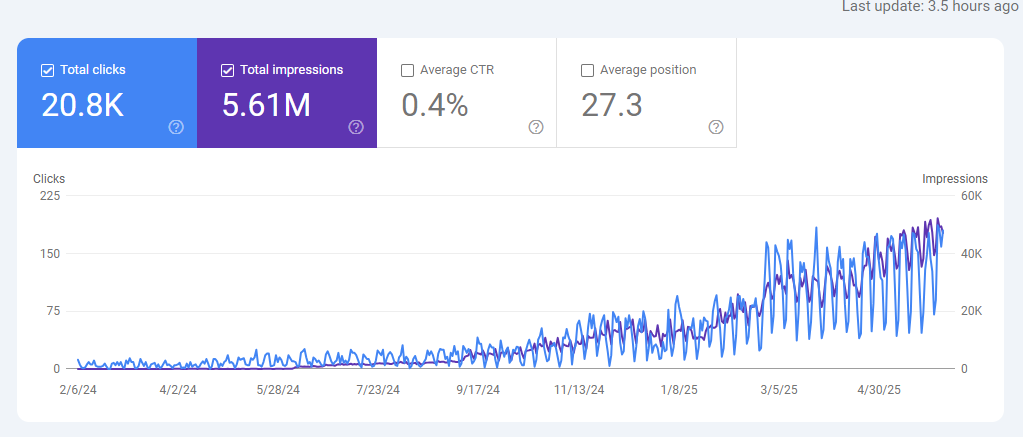
Non-Branded Click Growth (GSC):
- May 2024: 77 non-branded clicks
- December 2025: 8,964 non-branded clicks
- Growth: 11,542% increase
Total Organic Traffic Evolution (GA4 Sessions):
- May 2024: 756 organic sessions
- December 2025: 12,176 organic sessions (peak)
- Growth: 16x increase in under 20 months
Geographic Expansion into the US Market:
- USA Clicks May 2024: 12
- USA Clicks December 2025: 2,379
Ranking Dominance: Key Keyword Wins
The content strategy produced rankings for the highest-value terms in the legal tech space:
| Keyword Type | Ranking (Nov 2025) | Strategy Used |
|---|---|---|
| “Best [Category] Software” (listing) | #2 | Listing Blog + Image SEO |
| “[Primary Category] Tools” (category) | #1 | Content Audit + Interlinking |
| “Enterprise [Category] Software” (enterprise) | #1 | Solution Page Revamp |
| “[Core Workflow] Automation” (workflow) | #1 | Technical Audit + FAQ Schema |
These aren’t informational keywords — they’re the exact phrases typed by legal operations and procurement teams in active buying mode.
Lead Generation: The Ultimate Success Metric
While traffic growth was impressive, lead generation results proved the strategy’s effectiveness:
Marketing Qualified Leads:
- Generated 187 total MQLs over 20 months (May 2024 – November 2025)
- The Homepage alone secured 57 qualified leads during the tracking period — a result of CRO improvements and internal linking from high-authority blogs
- Peak performance: 23 MQLs in November 2024
Sales Qualified Leads:
- 46 SQLs converted from MQLs between January 2025 and November 2025
Customer Acquisition:
- 20 new customers acquired during the campaign period
Conversion Performance by Content Type: The data revealed which content types drove the highest-quality leads:
- Industry Landing Pages: 3.11% conversion rate (highest performing)
- Homepage: 0.99% conversion rate
- Comparison Blogs: 0.78% conversion rate
- Listing Blogs: 0.52% conversion rate generating 15+ leads
Content Production and Performance
Content Volume:
- 398 total pages published across 20 months
- 235 content pieces delivered via dedicated content team
- Consistent monthly publishing: scaled from 10 pages/month early on to 38 pages/month by August 2025
Content Distribution Strategy:
- 91 Blog Posts: Generated 6,885+ clicks (35.10% of total traffic)
- 15 Reviews + Pricing Pages: 1,215 clicks with strategic commercial intent
- 46 Glossary Terms: 1,492 clicks for educational content
- Multiple comparison and alternative pages targeting high-intent searches
Backlink Authority Building:
- 155 high-quality backlinks created over the campaign period
- Focus on DR 30-50 domains for natural, competitive-range growth
- Systematic approach of 7-10 backlinks per month maintained consistency
The Listing Blog Strategy: Highest-Performing Content Type
One of the most impactful decisions was investing heavily in “Listing Blogs” — articles that aggregate and compare solutions in the legal tech space (e.g., “Best [Category] Software” roundups).
The results were clear: listing blogs averaged 1,089 clicks per page — the highest average of any content type in the portfolio. Why do they work so well?
- They rank for high-volume, high-intent searches where users are actively comparing vendors
- They position the client as a trusted authority (one of the “best” options)
- Internal links from these pages to feature/solution pages directly influence purchase decisions
- They capture users who searched for a competitor but discovered our client as an alternative
The AI Overview Recovery Strategy
As Google rolled out AI Overviews in 2024-2025, many pages that previously held featured snippets saw click declines. Rather than accepting this loss, we engineered a systematic recovery approach:
The Problem: We identified 70+ pages affected by AI Overviews that were absorbing clicks that previously converted into site visits.
The Solution — “Takeaway” Sections: We implemented a specific TL;DR and FAQ Schema strategy:
- Added concise, crawlable “Takeaway” sections at the top of posts with the most important answer
- Structured these as standalone paragraphs that Google could cite and link back to the full article
- Implemented FAQ Schema to capture multi-part AI Overview appearances
The Result: Recovered 1,300+ lost clicks across the affected pages. Where most teams were watching AI Overviews erode their traffic, we turned it into a citation magnet.
Expanding Beyond Traditional Search
AI and LLM Presence: We successfully established presence in emerging search channels:
- 329 total LLM sessions in November 2025 (up from 0 in May 2024)
- ChatGPT: 121 sessions/month
- Perplexity: 165 sessions/month
- Claude, Gemini, Copilot: Active and growing referral sources
- Strong growth trajectory showing the site is being trained into LLM knowledge bases
Multi-Engine Performance:
- Bing organic clicks: Grew from 5 to 683 monthly clicks (peak: 851 in July 2025)
- Diversified search presence reducing dependency on Google alone
Tactical Execution: The “How”
Visual Interlinking Project
A dedicated “Visual Interlinking” project was executed to map and connect high-authority blogs to “Money Pages” (Feature and Solution pages). Using visual sitemap tools, the team identified orphaned pages, weak internal link equity, and missing pathways between top-of-funnel content and conversion pages.
Result: The Homepage alone received enough internal link equity to generate 57 qualified leads — more than most standalone blog posts.
Continuous Content Auditing
Rather than publishing and forgetting, the team ran 10 audits per week, systematically:
- Identifying “missing keywords” in Google Search Console (terms a page ranks for on page 2-3 that could be optimized to page 1)
- Refreshing content every 6 months to maintain rankings and add new data
- Correlating ranking stability directly with refresh frequency — pages that were audited and updated consistently showed significantly higher impression recovery
Conversion Rate Optimization (CRO) Integration
SEO and CRO worked together throughout the campaign:
- Persistent CTAs: Added “Book a Demo” banners to all blog content
- Template Downloads: Created downloadable legal document templates that captured lead data directly into HubSpot
- Departmental Targeting: Separate solution pages for Legal, Sales, and HR teams improved lead quality — feature pages showed higher lead quality despite lower traffic than blogs
Strategic Recommendations Implemented
Geographic and Market Focus
Recognizing the client’s need to penetrate the US market, we implemented specific strategies:
- US-Specific Content: Used American terminology and legal references
- Authority Building: Incorporated quotes from US-based subject matter experts
- Credible Data Sources: Cited US-focused statistics from sources like Statista and Pew Research
- Review Strategy: Focused on earning reviews from US users on G2 and Capterra
Content Enhancement and User Experience
Advanced Content Features:
- ROI Calculator Development: Created interactive tools to engage prospects
- Case Study Optimization: Enhanced existing case studies with SEO-focused titles and structure
- Video Integration: Replaced static testimonials with dynamic Storylane demo videos
Design and Conversion Optimization:
- Enhanced CTA Visibility: Added highlight effects to “Book a Demo” buttons
- Improved Table Design: Added jump links and better visual hierarchy
- Review Display Enhancement: Improved testimonial visibility with proper color coding and icons
Key Success Factors and Learnings
1. Quality Over Quantity in Lead Generation
The most important lesson was focusing on lead quality rather than traffic volume. Our overall conversion rate might seem low, but it generated leads that converted to actual customers. The 20 customers acquired via organic SEO vs. the paid ads that preceded us tells the full story.
2. Content Type Performance Insights
Industry-specific landing pages (3.11% conversion rate) significantly outperformed general blog content (0.06% conversion rate), proving the importance of targeted, commercial-intent content. Departmental targeting (Legal vs. Sales vs. HR) was essential for SaaS ROI.
3. Compound Growth Through Consistency
The results show classic SEO compound growth — slow initial progress followed by exponential gains. Non-branded clicks grew from 77 to 8,964, but the real acceleration happened after month 6. Scaling page production from 10 to 38 pages/month in the second year drove the traffic inflection.
4. AI Overview Optimization is the New Featured Snippet Game
Just as teams once optimized for featured snippets, the next frontier is engineering content to be cited by AI Overviews rather than replaced by them. The TL;DR + FAQ Schema approach worked because it gave Google’s AI exactly what it needed while still creating a reason to click through.
5. Multi-Channel Approach
Success came from diversifying beyond traditional Google organic search to include Bing, AI platforms (ChatGPT, Perplexity, Claude, Gemini), and LLM knowledge bases. LLM traffic grew from 0 to 329 sessions/month — a channel that barely existed when this campaign started.
Conclusion: A Blueprint for SaaS SEO Success
This case study demonstrates that with the right strategic approach, even a brand new SaaS in a competitive legal technology space can build a substantial organic lead generation engine — and eventually dominate it.
The key was focusing relentlessly on the client’s actual business goal — generating qualified leads — rather than chasing vanity metrics. Every content decision, every audit, every internal link was evaluated against one question: does this help someone in buying mode find and trust this product?
The transformation over 20 months:
- 16x organic traffic growth (756 → 12,176 sessions)
- 187 Marketing Qualified Leads generated
- 46 Sales Qualified Leads tracked
- 20 new customers acquired
- #1 rankings for enterprise-level legal tech keywords
- 1,300+ clicks recovered from AI Overview disruption
- 329 LLM sessions/month and growing
For B2B SaaS companies struggling with expensive paid acquisition costs, this case study proves that strategic, execution-focused SEO can become a primary growth driver — replacing ad spend with a compounding organic asset that works 24/7.
Results achieved through 20 months of strategic SEO implementation, May 2024 – December 2025